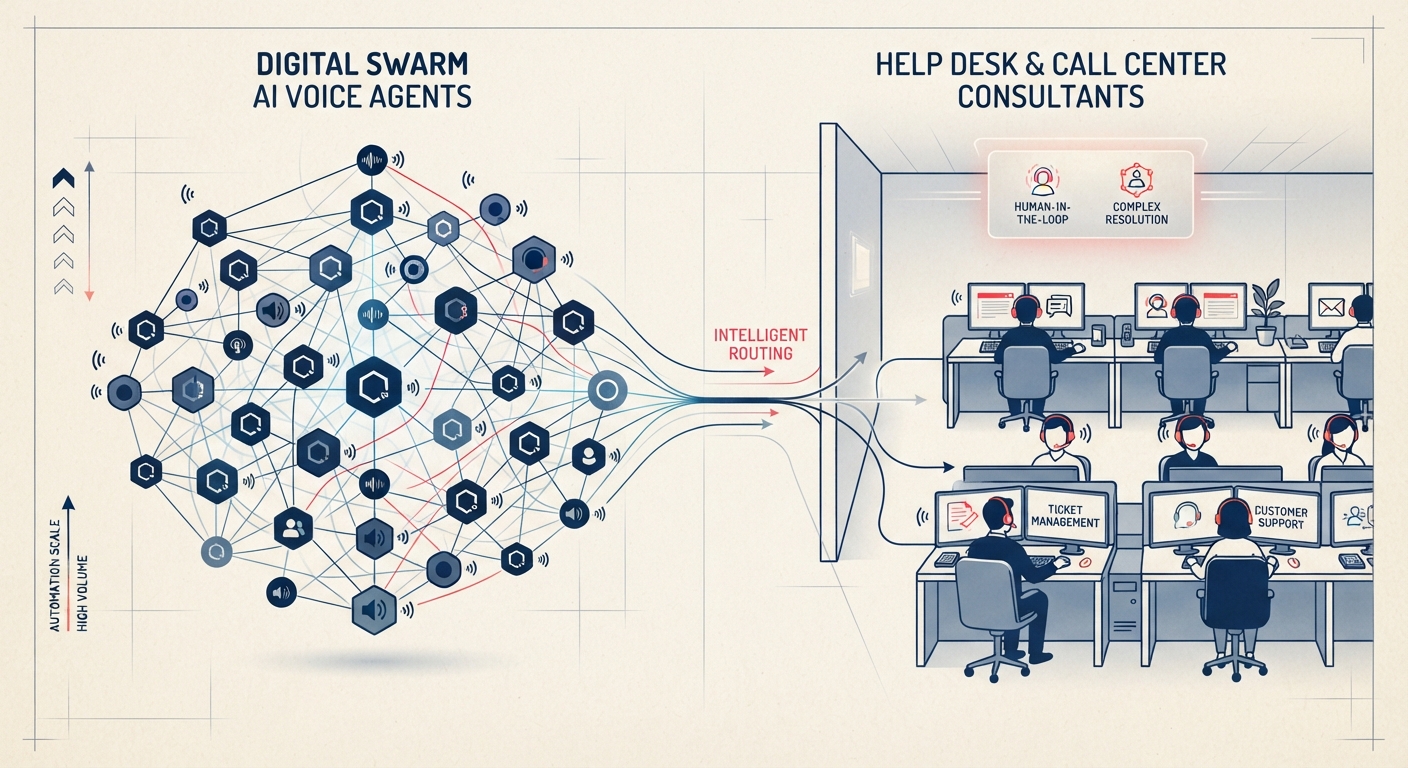
AI agents will increase call centre traffic, not reduce it. Customers' personal assistants have none of the time, patience or emotional barriers that used to hold contact volume down.
A new type of traffic is emerging: Agent-to-Business (A2B). Cancellations, complaints and chargebacks, status queries and price negotiations, raised 24/7.
Hiring more human agents is not economically justified. The answer is your own inbound voicebots and intent routing, with human-in-the-loop procedures.
Success metrics: Ticket Deflection Rate and MTTR (Mean Time to Resolution).
Instead of the promised mass layoffs and the end of the hotline, we are entering an era of digital tsunami. When every customer has a personal AI assistant able to make phone calls on its own, traditional enterprise customer service will have to go through a revolution.
Introduction: 60 billion dollars to book a table?
Corporate technology has a common narrative: artificial intelligence will eliminate the traditional call centre, and operating costs (OPEX) in support departments will fall to zero thanks to static chatbots.
There are two sides to this. On one side, huge budgets are going into advanced models capable of autonomous planning. On the other, ironically, the most expensive systems still struggle with a task as mundane as correctly booking a restaurant table. Yet when we look more closely at how personal agentic systems are developing (a topic widely discussed in recent industry analyses and technology podcasts such as Hard Fork), the conclusions for business leaders are quite different from what the optimistic forecasts suggest.
We are moving from the era of passive text interactions to the era of agentic AI: autonomous agents acting on behalf of users. And they will soon start calling your company in large numbers.
Why will customers “unleash” their agents? (No psychological brakes)
For years, the volume of contacts to call centres and helpdesks was naturally held back by human limits. Customers simply couldn't be bothered with tedious tasks. They put them off or gave up because of psychological and practical barriers:
- The time and patience barrier: Who enjoys spending hours in IVR queues to sort out a small discrepancy on an invoice?
- Emotional reluctance: Calling to complain, a difficult conversation about cancelling a subscription, raising a grievance or negotiating contract terms all involve confrontation and discomfort.
An AI agent has no emotions, no fatigue and no fear of confrontation.
In the near future your customer will simply hand the task to their assistant (modelled on the voice solutions being developed by big tech, such as Meta's agents): “Check whether I can lower my subscription bill”, “Cancel this subscription and demand a refund for the delay” or “File a complaint about the damaged parcel”. The assistant will dial the hotline without hesitation, work through the IVR and start enforcing the customer's rights 24/7.
A wave of new hotline topics (Agent-to-Business)
Instead of fewer calls, companies need to prepare for an entirely new wave of traffic generated by machines talking to people or to other internal systems. The most common scenarios that will flood customer service departments include:
| Scenario | What the customer's AI agent does |
|---|---|
| Mass cancellations and switching (churn automation) | Systematically audits the user's spending, automatically looks for cheaper alternatives and starts cancelling existing services. |
| Automated complaints and chargebacks | Reports minor quality shortfalls immediately, as formal tickets or voice calls, without batting an eyelid. |
| Constant confirmations and status checks | Keeps checking order statuses, asks for delivery details and demands immediate verification of contract changes. |
| Tariff and price negotiations | Bargains hard for better terms on the owner's behalf, testing how flexible sales departments are. |
How should companies prepare? (Bigger teams or an agentic AI counter-offensive?)
Forecasts that assume AI will let us close hotlines entirely may prove misleading. If demand for contact from customer agents grows many times over, traditional customer service departments will be paralysed at once.
Boards and operations leaders (COO/CTO) face a strategic dilemma:
These systems must be able to exchange data rapidly with customers' external assistants via API, without involving people in every minor check. Key performance indicators such as Ticket Deflection Rate and MTTR (Mean Time to Resolution) will become the main measures of operational success.
| Metric | What it measures |
|---|---|
| Ticket Deflection Rate | The share of requests resolved automatically, without a human agent. |
| MTTR (Mean Time to Resolution) | The average time from receiving a request to resolving it. |
Summary: what do you need to do in your organisation?
An AI strategy for customer service is no longer an optimisation option. It is becoming a defensive necessity. To prepare your company for the coming wave:
- Review your inbound architecture: Is your current call centre ready for a sudden, step-change increase in machine-to-human interactions?
- Introduce inbound voicebots: Move mass, repetitive queries to autonomous voice channels integrated with your ERP/CRM systems, while keeping human-in-the-loop procedures.
- Look after your cost architecture: Avoid the risk of cloud bill shock by optimising the cost of inbound queries with well-designed model routing.
Planning to deploy AI agents, or want to assess how ready your company is for the coming transformation of the hotline? Contact the Adopt AI Labs team and see our dedicated implementation framework.
Frequently asked questions
Will AI agents reduce the number of calls to call centres?
More likely they will increase it. Until now, contact volume was held back by human limits: lack of time, lack of patience and a reluctance to confront. A customer's personal AI agent has none of these barriers, so it will call about issues the customer used to postpone or abandon, 24 hours a day.
What is Agent-to-Business (A2B) traffic?
It is contact with a company initiated by AI agents acting on behalf of customers. The most common scenarios are cancellations and switching to cheaper services, automated complaints and chargebacks, constant order-status queries, and tariff and price negotiations.
How should a call centre prepare for calls from AI agents?
Hiring more agents to handle repetitive bot-generated queries is not economically justified. A more effective approach is to deploy your own inbound voicebots and intent routing that exchange data with customers' assistants via API, integrated with ERP and CRM, with human-in-the-loop procedures for complex cases.
Which metrics show how well AI agent traffic is being handled?
The two main metrics are Ticket Deflection Rate, the share of requests resolved without a human agent, and MTTR (Mean Time to Resolution), the average time from request to resolution.
What does human-in-the-loop mean in customer service?
It is a procedure in which the AI system handles repetitive cases on its own and hands complex, unusual or decision-heavy cases to a human agent. People keep control over decisions while AI absorbs the volume.